
The Problem with Traditional Sales Training
For decades, sales enablement teams have relied on the 'sit-and-get' method: classroom lectures, slide decks, and recorded webinars. While these methods are easy to deploy, they often fall flat when it comes to long-term retention. According to the Ebbinghaus Forgetting Curve, learners forget approximately 70% of new information within 24 hours if it is not applied. When it comes to complex skills like objection handling training, passive learning is simply insufficient. Reps may understand the theory of a 'feel, felt, found' technique in a room, but they freeze up when a prospect pushes back on price or contract terms in a high-stakes call.
Why Passive Learning Fails in Sales
The gap between knowledge and execution is where most sales pipelines stall. Traditional training often ignores the 70-20-10 model of learning, which posits that 70% of development happens through experiential practice. When you rely solely on role-plays with managers—which are often sporadic and subject to bias—you miss the opportunity for consistent, measurable skill development. The modern sales environment requires a shift toward active, experiential learning that mirrors the pressure of actual customer calls.
What is Sales Coaching AI?
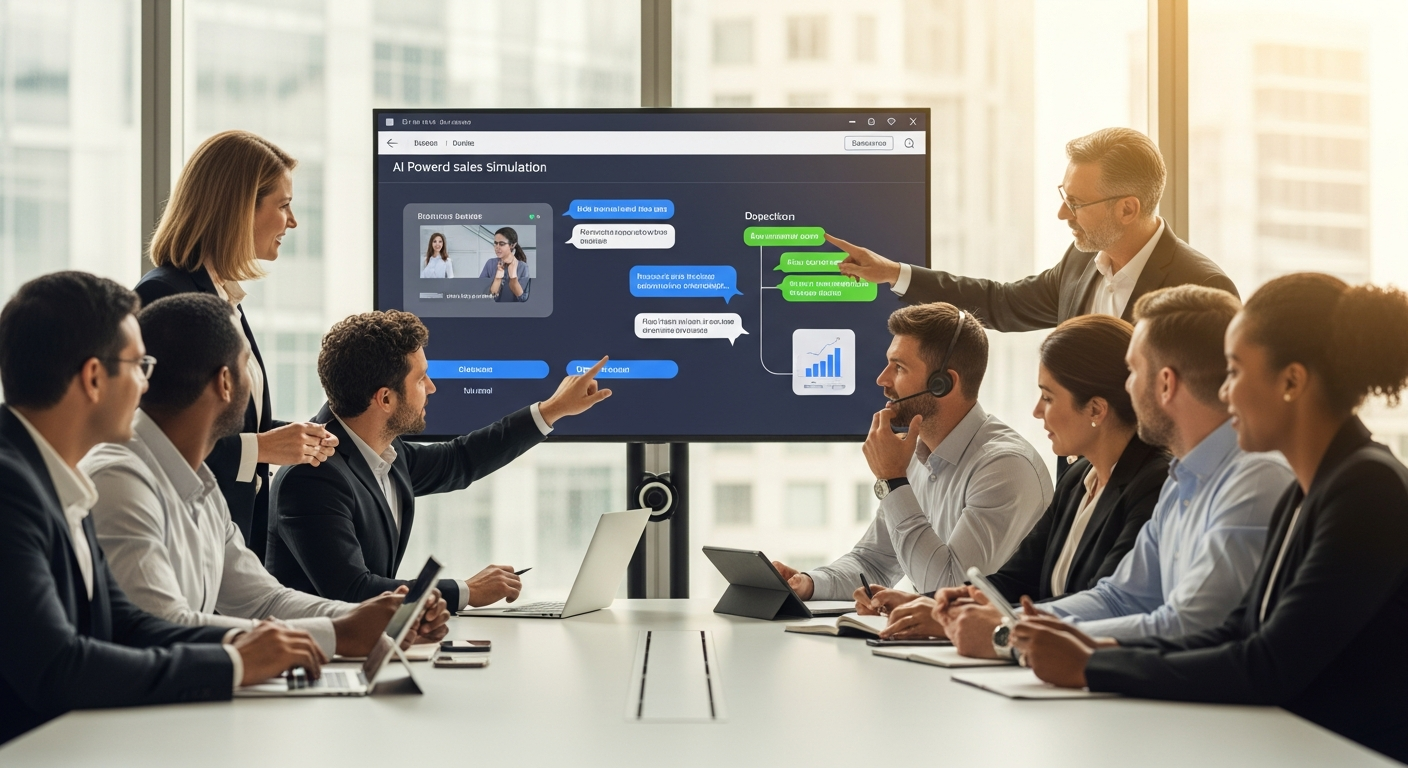
Sales coaching AI refers to the use of generative intelligence to create dynamic, responsive training environments that simulate real-world prospect interactions. Instead of a static script, a rep engages with an AI-driven persona that reacts in real-time to their inputs. If the rep stumbles, the AI pushes back with a more difficult objection. If they succeed, the scenario evolves. This creates a safe, 'fail-fast' environment where reps can test new messaging without risking actual revenue.
The Benefits of AI-Driven Simulations
- Scalability: Unlike human-led role-plays, AI simulations are available 24/7, allowing reps to practice on their own schedule.
- Emotional Intelligence Development: AI can be programmed to mimic diverse buyer personalities, from the 'skeptical CFO' to the 'rushed procurement lead.'
- Real-time Feedback loops: Immediate evaluation of speech patterns, clarity, and adherence to messaging frameworks ensures that bad habits are corrected before they reach the customer.
- Measurable ROI: Every interaction provides data points on confidence, sentiment, and success rates, allowing L&D teams to map training directly to performance metrics.
How to Build Realistic Objection Handling Scenarios
To move from passive theory to active mastery, training must be grounded in specific, high-frequency customer objections. Use the following four-step framework to build your next simulation cycle.
1. Identify the 'Moment of Truth'
Don't try to simulate an entire sales cycle. Focus on the inflection point. Is your team struggling with budget pushback, or is it the 'competitor comparison' objection? Extract the exact phrases from your call recording software (Gong, Chorus, etc.) and use these as the training foundation.
2. Define the Persona Profiles
Use AI to generate specific personas. A 'Price-Sensitive Manager' and a 'Status-Quo Defender' require completely different responses. By rotating through these personas, reps learn that objection handling is not about memorizing a script, but about active listening and value articulation.
3. Implement the Feedback Loop
Follow the Kirkpatrick Model of Evaluation. Ensure that your simulations don't just measure 'Reaction' (did they like the training?) but 'Behavior' (did they use the new talk tracks on actual calls?). Use your coaching AI to provide scorecards based on predefined criteria, such as acknowledging the objection, pivoting to value, and checking for agreement.
4. Create Iterative Drills
Practice should be frequent, not episodic. Use 'micro-drills'—10-minute AI simulations that reps complete twice a week. This combats the forgetting curve and builds muscle memory.
Comparative Analysis: Traditional Role-Plays vs. AI-Simulated Practice
| Feature | Traditional Peer Role-Play | AI-Driven Simulation |
|---|---|---|
| Availability | Scheduled/Ad-hoc | On-Demand 24/7 |
| Consistency | Highly Variable (Peer bias) | Standardized/Objective |
| Feedback Quality | Subjective/Delayed | Immediate/Data-Driven |
| Pressure Level | Low (Peer comfort) | Realistic (Persona pressure) |
| Scaling | Low (Requires Manager time) | High (Infinite parallel sessions) |
Scaling Behavioral Change Across the Enterprise
For HR and L&D leaders, the objective is to move the needle on revenue. If your objection handling training is not tied to behavioral change, it is merely an expense, not an investment. To ensure success, you must treat your sales force like athletes. Athletes don't watch videos of games to improve; they run drills. AI-powered practice environments turn the training experience into a recurring drill.
Aligning Training with Business Outcomes
- Data-Informed Onboarding: New hires often struggle with the most complex objections. Use AI to identify which reps are 'stuck' in the simulation and offer targeted human coaching intervention.
- Safe Experimentation: If you are launching a new product, run your reps through 50 AI simulations before they speak to a single prospect. The data gathered from these sessions will reveal if your new messaging is clear or confusing.
- Compliance and Standardization: For enterprise teams, ensuring that every rep handles objections in a way that is compliant (e.g., avoiding legal liability in contract negotiations) is critical. AI allows you to bake compliance guidelines into the simulation rubric.
Conclusion: The Future of Sales Enablement
The days of assuming that a one-hour seminar will change how a sales rep handles a difficult negotiation are over. By leveraging AI to facilitate realistic, iterative, and measurable practice, you provide your team with the tools to handle customer objections with confidence. The transition to experiential learning isn't just about adopting new technology—it's about creating a culture where practice is continuous, feedback is objective, and every training dollar is mapped directly to measurable behavioral change. Start small: convert your top three most common objections into a 10-minute AI simulation this week and watch your team's confidence rise.